


Jerónimos Monastery


The area of Restelo, historically associated with Belém, was, by the end of the fifteenth century, a small village and sheltered harbour serving the city of Lisbon. With improvements in ocean-going vessels, the development of longer-distance voyages, and the beginning of Portuguese maritime expansion, the settlement grew in both importance and population. In 1459, in recognition of the area’s maritime vocation, Prince Henry the Navigator ordered the enlargement of an existing small chapel, originally dedicated to Our Lady of the Star. Following its donation to the Order of Christ, the chapel adopted the dedication of Our Lady of the Kings, or Saint Mary of Belém.
From here departed Vasco da Gama’s caravels—having prayed and kept vigil in this chapel on the eve of the fleet’s departure for India, on 7 July 1497—and those of Pedro Álvares Cabral, bound for Brazil in 1500.
In 1495, King Manuel I petitioned the Holy See for permission to establish a hermitage for Hieronymite monks on the site of the chapel belonging to the Order of Christ, a concession he obtained the following year. Three years later, the monarch granted the site at Restelo to the influential Order of Saint Jerome as the location for the construction of the future monastery. The choice of this Order, closely associated with the Castilian dynastic cult, was not accidental; rather, it reflected Manuel I’s ambition for a future dynastic union—a strategy rooted in his marriage policy, which involved two successive marriages to daughters of the Catholic Monarchs
![Cascale Lisitaniae opp[idula] / [Georg Braun, Frans Hogenberg] Colónia 1572](https://mosteirojeronimos.torrebelem.gov.pt/uploads/Braun_JERONIMOS_UBHD_96642baba9.jpg)
On the symbolically significant day of 6 January, in either 1501 or 1502, the Feast of the Epiphany, the foundation stone for the construction of the new monastery was laid. The feast of the Three Wise Men—who, having come from different parts of the world, brought gifts of great symbolic significance to the Christ Child—allows a parallel to be drawn with a new Bethlehem, a new point of departure for Christendom.
The stone used in the construction of the Jerónimos Monastery was predominantly lioz, a type of limestone known for its light colour, great durability and abundance of fossils. It was quarried locally, in nearby quarries such as those of Rio Seco, Ribeira da Ajuda and Alcolena, Raposeira, Vinhas, and Laveiras in Caxias. The exception is the High Chapel, built between 1557 and 1562 in Estremoz marble, on the initiative of Queen Catherine.
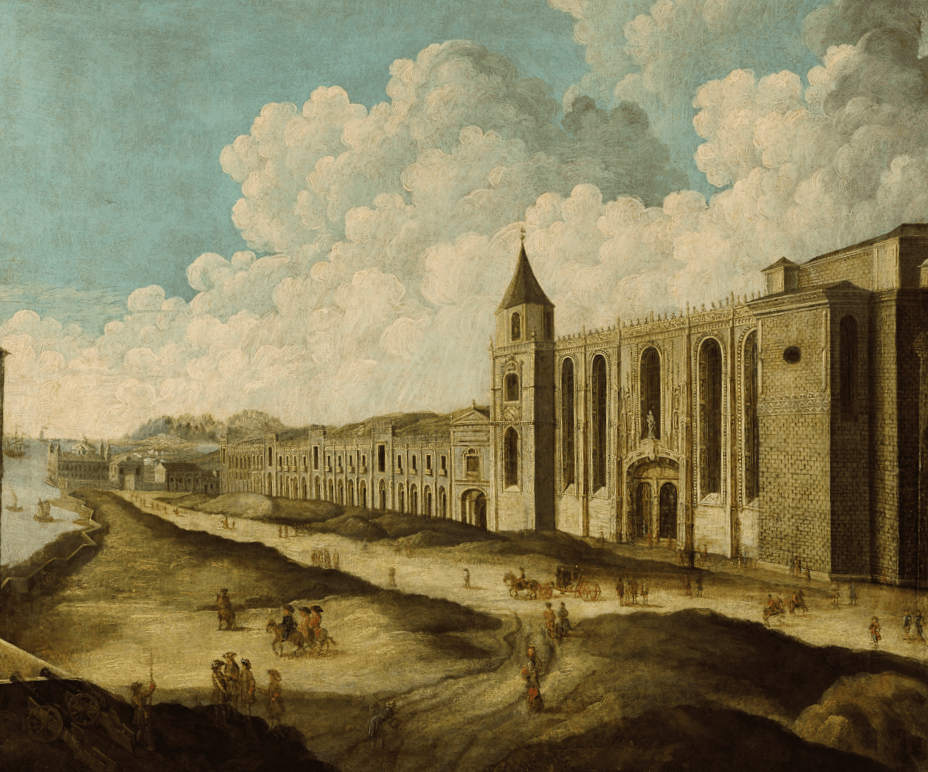
Images and photographs
1 – Detail showing the Belém Tower and Jerónimos Monastery from Civitates Orbis Terrarum, Band 1, 1572, by Georg Braun and Frans Hogenberg
2 – View of Belem Monastery near Lisbon, c. 1660–1670, by Dirck Stoop